Looking for a last minute gift for an ant aficionado or nature enthusiast? Army Ants: Nature’s Ultimate Social Hunters* by Daniel J. C. Kronauer is the perfect choice.

 (*Amazon Affiliate Link)
Written to be accessible for the general audience, the book features Kronauer’s eye-catching, gorgeous full-color photographs. In fact the illustrations might make you think it could be a coffee table book, but don’t be fooled. Army Ants is full of serious, sometimes cutting-edge science, too.
What’s in the book
In the prologue, the reader learns about how popular culture has viewed army ants, as well as a quick introduction to the rest of the book. Kronauer explains he will focus on two species, Eciton hamatum and Eciton burchelli.
Chapter One starts with the recognition of Eciton army ants by early European naturalists and the problems they had naming the species. It is a fascinating bit of scientific history and took some effort to untangle. Eventually, the taxonomy is sorted and science progresses.
In Chapter Two, readers discover how different groups of army ants fit in with other ants in the evolutionary tree, how they are different from one another and how they are similar.
The next chapters cover specialized army ant biology: mass raiding, nomadic lifestyle, and reproducing via colony fission.
Chapter Three discusses how army ants forage for prey during raids. For example, Eciton hamatum specializes in preying on ants and social wasps, whereas Eciton bruchelli raids ants as well as many other arthropods. Do Eciton army ants raid the other abundant ants in the area, leafcutters? You will find out. He also mentions butterflies, flies, and birds that follow the raiding columns ( previous post describes antbirds).
Chapter Four delves deeply into the colony life cycles of the different species. Army ants cycle between a nomadic phase when they move from place to place, and a statary or settled phase when the ants stay in one place for a few weeks. When they are statary, the ants form a living nest with their own bodies called a bivouac. All those ants working together to produce a physical structure that can even regulate the temperature and humidity inside is pretty amazing.
Chapter Five reveals how army ant colonies reproduce via fission, where colonies split up workers into two (or more) groups, one following the established queen and the other with a new, young queen. It is reminiscent of the swarming process in honey bees.
The final chapter, aptly named “The Traveling Circus”, focuses on all the other arthropods that live with, on, and travel with army ants. Mites and beetles are particularly common myrmecophiles. Some of their adaptations to life with army ants are mind blowing. On page 266 check out the mite that attaches to and takes the function of the tarsi of an army ant.
In the back matter is a full glossary, tons of references, and an index.
Discussion
Army Ants is both an entertaining read and a good general reference to this specialized group of ants. Kronauer’s enthusiasm for his subject and expertise shine through on every page. Even someone who knows quite a bit about ants will probably find things that are new.
One unexpected aspect of reading the book the ability to armchair travel to tropical locations at a time when travel currently not an easy option. Although Kronauer doesn’t write about his adventures in great detail, on page 222 he mentions receiving the news that a colony of army ants was getting ready to fission and immediately booking a flight to Costa Rica to observe it. That’s a lifestyle most of us only dream about. By reading the book, we get to travel along with him.
If you are interested in ants or know someone who is, grab a copy of Army Ants today!
Publisher : Harvard University Press (October 6, 2020)
ISBN-10 : 067424155X
ISBN-13 : 978-0674241558
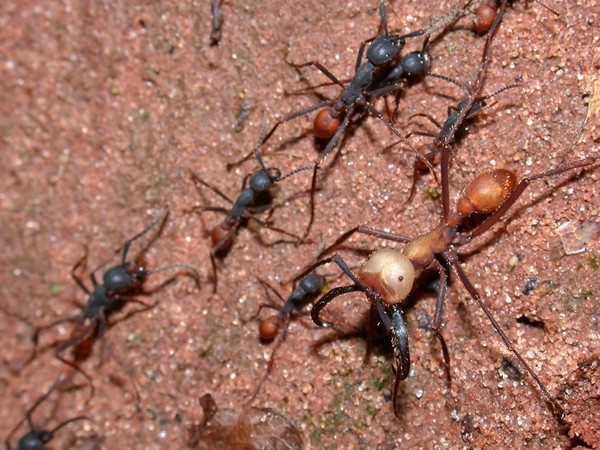
(Featured post image is a public domain photograph of Eciton burchelli by Alex Wild)
Disclosure: This book was provided by the publisher for review purposes. Also, I am an affiliate with Amazon so I can provide you with cover images and links to more information about books and products. As you probably are aware, if you click through the highlighted title link and purchase a product, I will receive a very small commission, at no extra cost to you. Any proceeds help defray the costs of hosting and maintaining this website.